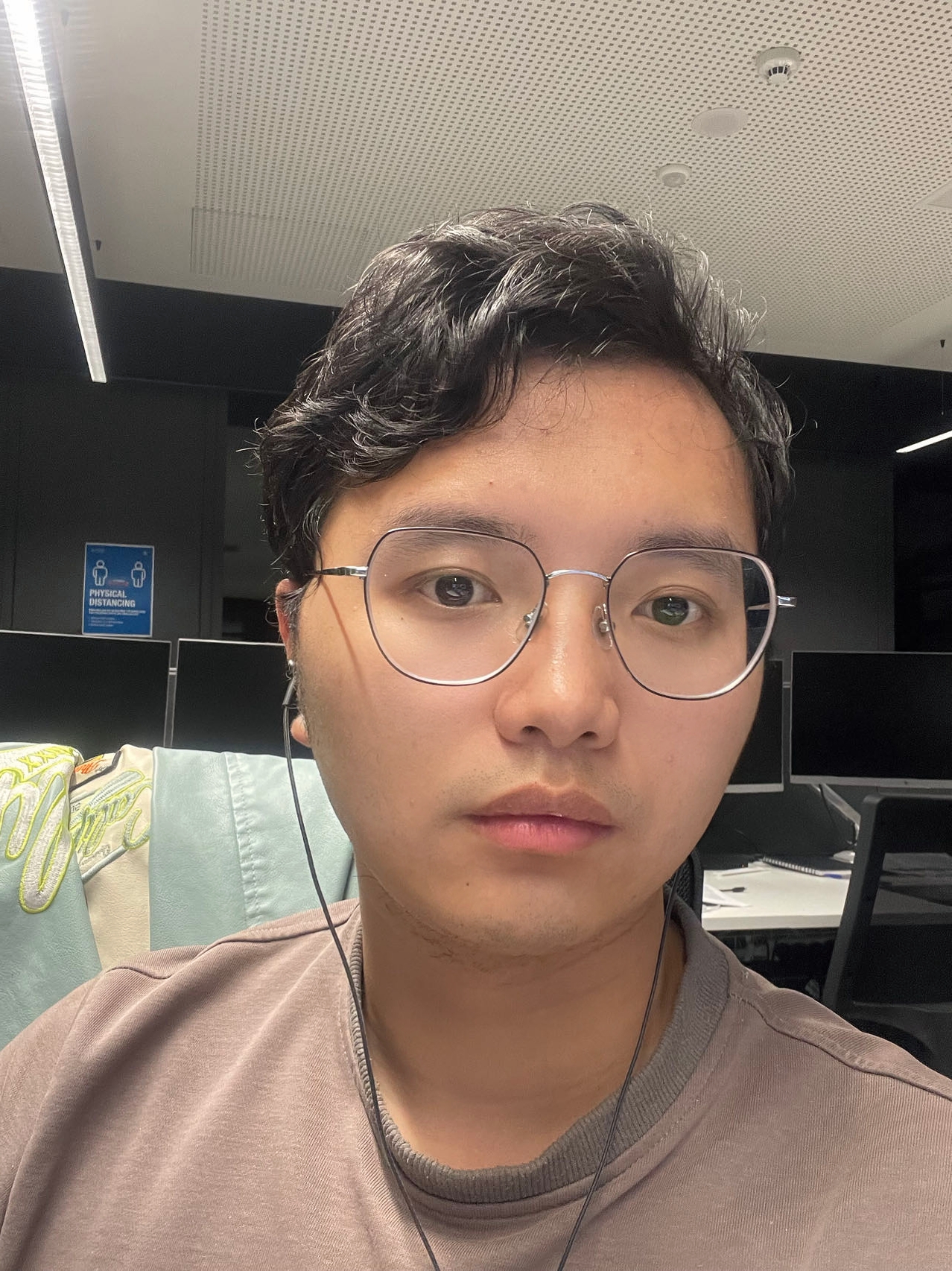
Han Hu 胡晗
About Me
I am Han Hu (胡晗), a Research Scientist at Huawei Hong Kong Research Center (Feb 2025 – Present).
At Huawei, I work on evaluation-driven optimization for coding agents and Code LLMs in HarmonyOS/OpenHarmony app development.
I hold a Ph.D. in Computer Science from Monash University (Jul 2021–Dec 2024), an M.S. from Tsinghua University, and a B.S. from UESTC.
My Ph.D. research produced 5+ first-author CCF-A / CORE A* papers across top AI and software-engineering venues, with work at NeurIPS, ICLR, FSE, ICSE, and TOSEM.
AI Coding: Coding Agent Evaluation & Optimization · Code LLM Post-training (SFT/RLHF) · Benchmarking
AI for Software Engineering: GUI Agent · LLM-assisted Program Analysis · Client-side Performance Optimization
Research Interests
① AI Coding: Eval-driven Agent & LLM Improvement (Core)
I serve as the system architect (SE) for OpenHarmony Bench. I also lead its spec-driven core benchmark for evaluating LLMs and coding agents on OpenHarmony ArkTS app development. Selected from dozens of related efforts, it is the officially recognized benchmark for OpenHarmony AI Coding, with the official website serving as the public entry point. We will continuously update the leaderboard to track the latest LLM and coding-agent capabilities on OpenHarmony development.
This work was featured in the official ArkTS AI Coding white paper released at the HDC 2026 main conference. Building on this evaluation platform, we continue to pursue eval-driven research on coding agents, Code LLM optimization, and self-evolving software-development systems. As part of this broader evaluation-and-optimization effort, DevEco Code has achieved the strongest performance among evaluated open-source LLM+agent baselines for ArkTS coding tasks.
(DevEco Code · OpenHarmony Bench · BigCodeBench · StarCoder 2)
② AI Infrastructure & Performance Optimization
This line of work focuses on AI-assisted performance diagnosis and binary/code understanding for client-side software, including mobile-binary compiler optimization detection (ASE 2026) and redundant GPU/thread detection (FSE 2026). The core work, ArkAnalyzer-HapRay, achieves 20% GPU and 3–5% CPU improvements in key scenarios and was selected for HDC 2026 as a showcased performance-analysis tool. My related first-author high-potential patent has been adopted into DevEco Studio.
(ArkAnalyzer-HapRay · DevEco Studio · ASE 2026 · FSE 2026)
③ GUI Agent
My earlier GUI-agent work covers mobile app exploration, cross-device GUI adaptation, and behavior verification across Android, iOS, and HarmonyOS. It now serves as the executable verification foundation for AI Coding evaluation, with first-author work at NeurIPS and TOSEM.
(GUI Agent · App Automation · Dynamic Verification · NeurIPS · TOSEM)
Collaboration & Opportunities
Our team, based in Hong Kong, is currently open to research interns (long-term recruitment, applications accepted year-round) and full-time researchers focusing on AI Coding, Code LLM evaluation/post-training, coding-agent evaluation and optimization, and GUI-agent-based verification.
We can support visa applications and offer a highly competitive compensation package for qualified candidates.
If you are interested in collaborating on research projects or joining our team, please feel free to contact me at agmaiofhuhan@gmail.com.
Profile Sharing Notice
This page and my CV are for personal reference only. Please do not submit, forward, or share my profile, this page, or any version of my CV to recruitment agencies, talent programs, or third-party platforms without my explicit prior consent.
Latest News
- 2026/08: OpenHarmony Bench was released with its official website, leaderboard, and arXiv technical report.
- 2026/06: An earlier version of OpenHarmony Bench was selected and featured in the official ArkTS AI Coding white paper released at the HDC 2026 main conference.
- 2026/06: Our paper Source-Free Detection and Impact Analysis of Compiler Optimization Problems in Mobile Applications was accepted at ASE 2026.
- 2025/10: Our paper Phantom Rendering Detection: Identifying and Analyzing Unnecessary UI Computations was accepted at FSE 2026.
- 2025/10: Our paper InterIDEAS: Philosophical Intertextuality via LLMs was accepted at EMNLP 2025 and received the Best Special Theme Paper Award.
- 2024/12: I was awarded the Doctor of Philosophy degree! I am now Dr. Han Hu. From July 2021 to December 2024, what a memorable journey my PhD has been!
- 2024/09: Our paper Pairwise GUI Dataset Construction between Android Phones and Tablets was accepted at NeurIPS 2024.
- 2024/07: We release BigCodeBench. Feel free to visit its GitHub homepage for more details.